The AI-Enhanced Meeting: Improving Access and Driving Better Outcomes
Learn how AI-enabled meeting technologies can improve accessibility, equity, and productivity in public sector and education environments by reducing technical friction and enabling more inclusive participation.
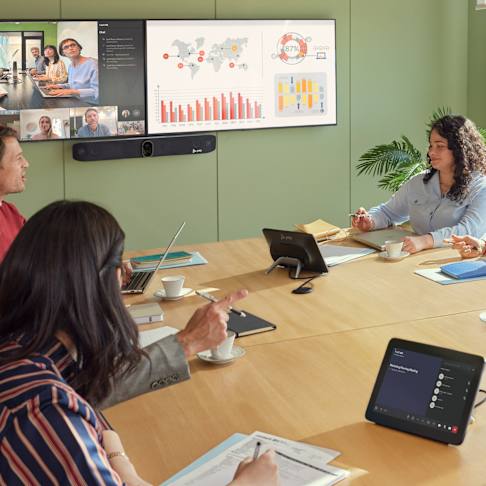
A GOVERNMENT TECHNOLOGY THOUGHT LEADERSHIP PAPER
The AI-Enhanced Meeting: Improving Access and Driving Better Outcomes
SPONSORED BY
Public sector meetings should bring together agency leaders, staff and residents in an equitable, accessible way.
But too often, conventional audiovisual tools fail to capture nuances of human conversations or provide an equal platform.
That’s changing with the advent of AI and machine learning tools designed to broaden engagement no matter where participants are located. From accounting for bad lighting to providing real-time translations, deploying these AI-enabled solutions can significantly improve communication.
Today’s Top Meeting Challenges
Equity: The modern workforce is a mix of in-office, remote and hybrid employees. Many team members may need to join meetings from the field. Staff and constituents may include non-English speakers and people who require transcripts.
“Remote and hybrid work exposed long-standing inequities in who speaks, who is heard and who influences outcomes,” says Sean McSpaden, a senior fellow with the Center for Digital Government (CDG). “Expectations have shifted significantly from simply being present to being meaningfully engaged.”
Consistency: Meeting attendees use devices with cameras, microphones and network bandwidth that are all over the map.
“It’s very frustrating to be in a meeting where a person’s cutting in and out,” says Daniel Gohl, HP’s chief technology and strategy officer for U.S. state and local government and education.
One device may render a speaker’s face too small; another might have poor lighting or audio. Office spaces that were never designed to host hybrid meetings may have poor sound quality.
Collaboration: Hybrid participants expect collaboration tools to level the playing field with features like real-time chat, polling, transcription and shared digital workspaces.
As agencies work to address these challenges, the next step is exploring how AI-powered solutions can help create more inclusive, reliable and engaging meeting experiences.
AI In Action
Too many meetings rely on real-time discussions when today’s collaboration tools, large learning models (LLMs) and high-speed networks allow meetings to be recorded and transcribed. People can get the information they need from a meeting at their own convenience.
The latest AI-enhanced computers and collaboration solutions have processors designed specifically to manage advanced workloads. These improve:
User experience: AI-enhanced meeting spaces and collaboration software improve consistency for participants. AI algorithms reposition faces to make sure everyone can be seen. AI can also equalize light, adjust contrast and reduce shadows.
In terms of sound quality, AI brings consistency across devices, environments and vocal volumes. Algorithms detect and filter out echoes, background noise and other distractions.
“It’s a producer, it’s a director, it’s a camera staff,” Gohl says. “Every room is going to be a little different. AI is hearing, seeing and then adjusting what goes on just like a good studio technician would.”
Accessibility: Consistent experiences reduce barriers to participation, improving accessibility. Remote staff don’t have to feel that working outside the office limits their contributions. AI follows and emphasizes who is speaking, providing remote participants the same context as in-office attendees.
With real-time transcripts and translation options, all residents can participate in the meeting without waiting for transcripts to be released.
Productivity: Participants can devote more attention to the purpose of a meeting because they’re not bogged down in the technical details of operating different equipment. Modern, AI-enhanced meetings also lay a foundation for adopting agent-based AI tools in the future.
Additionally, meetings don’t get derailed by connection issues or technical difficulties. When everyone can communicate efficiently, important discussions finish on time.
Best Practices
Establish standards: Start by identifying audiovisual quality guidelines that must apply to all meeting spaces. AI solutions are built to equalize and enhance settings, but they need something to build from. Determine how many cameras will be in each room, where people will sit and how lighting might be adjusted.
“Technology has surpassed our expectations, so create templates of what a city, county or school district meeting needs to accomplish,” Gohl says.
Measure progress: Collect data on meetings to assess the user experience. Meeting telemetry and data
archives provide the number of people in the room, the systems they’re using and video bandwidth consumption. End-of-meeting surveys can give a better picture of staff satisfaction.
Accommodate AI: Advanced technology works best when paired with modern workstations. Today’s AI-enabled computers are built for these types of workloads. While it may not be possible to replace every computer at once, agencies should begin adding next- generation machines to their fleet.
Even one AI-enabled device can provide an organization with opportunities for significant improvement.
Create governance: AI policies must encompass fairness, equity and empathy, eliminating biases and protecting sensitive private data. A governance group should create clear, consistent guidelines for developing and using AI. Make sure the guidelines are regularly reviewed and updated.
Follow the fundamentals: Technology shouldn’t distract leaders from the purpose of meetings. There’s no substitute for drafting a prepared agenda, understanding collaboration technology, providing clear guidance and creating intentional pauses for feedback.
“In many public sector environments, meeting quality has become a visible indicator of leadership effectiveness in this new hybrid work environment,” McSpaden says.
Elevating Communication
When technology works reliably and fades into the background, people can focus on decisions, dialogue and outcomes.
AI won’t fix every meeting problem, and it shouldn’t try to replace good leadership, clear agendas or thoughtful facilitation. What it can do is remove friction that has quietly shaped who participates and who struggles to be heard.
AI polices must encompass fairness, equity and empathy, eliminating biases and protecting sensitive private data.
Produced by Government Technology
Government Technology is about solving problems in state and local government through the smart use of technology. Government Technology is a division of e.Republic, the nation’s only media and research company focused exclusively on state and local government and education.
www.govtech.com
This piece was written and produced by the Government Technology Content Studio, with information and input from HP Inc and Intel Corporation.
Sponsored by HP Inc and Intel Corporation
HP Inc. is a technology company that believes one thoughtful idea has the power to change the world. Its product and service portfolio of personal systems, printers, and 3D printing solutions helps bring these ideas to life.
www.hp.com/HPSolutions-StateandLocalGov
Intel Corporation is a company with the purpose to create world-changing technology that improves the life of every person on the planet.
www.intel.com
©2026 e.Republic LLC. All rights reserved.
http://www.govtech.com https://www.hp.com/us-en/solutions/statelocal-government-it-solutions.html?jumpid=va_us_na_mk_hc_r12129_aw_x_11567 https://www.intel.com/content/www/us/en/homepage.html