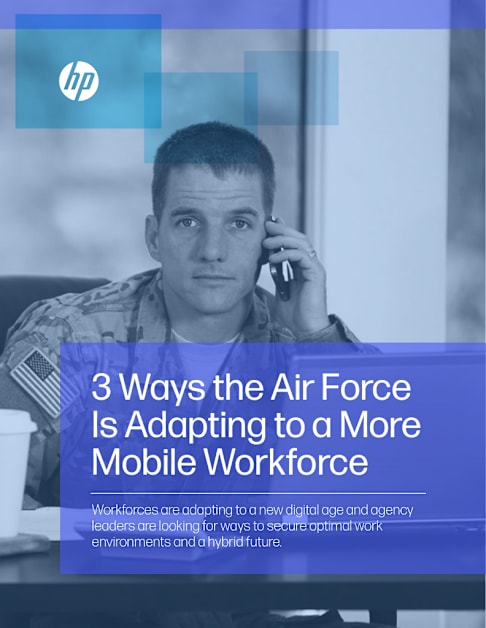
3 ways the Air Force is adapting to Mobile Workforce

3 Ways the Air Force Is Adapting to a More Mobile Workforce Workforces are adapting to a new digital age and agency leaders are looking for ways to secure optimal work environments and a hybrid future.
© Copyright 2023 HP Development Company, L.P. The information contained herein is subject to change without notice. 1
Introduction
Hybrid work is here to stay and government agencies have been on a mission to support employees and enable them to do their best work wherever they are. But as organizations embark on their workforce transformations, they’re tasked with mitigating risks to national security and supporting an ever-evolving digital infrastructure. Now, agencies are looking for solutions to enable hybrid workforces as they continue to adapt and grow.
The Air Force has set its sights on fostering the optimal hybrid environment for
employees by embracing flexible workstyles and new technologies.
To discuss the Air Force’s approach to mitigating challenges with remote work and the best practices and policies the organization has implemented in order to maintain efficient, hybrid workforces, experts from GovExec and HP sat down with senior defense leaders in the Air Force. During the event, sponsored by HP and Intel, experts broke down how they implemented a meaningful hybrid approach and offered advice to government agencies on a similar mission.
Build Flexible Work Environments
1
Leveraging Collaborative Technology
2
Embrace a New Culture of Work
3
https://events.govexec.com/tomorrows-workforce/
“Flexibility and personalization of the optimal workplace is going to look different for everyone, so keeping that line of communication open is crucial to helping employees do their best work.”
Brian Lau Product Manager, Future of Work, HP
© Copyright 2023 HP Development Company, L.P. The information contained herein is subject to change without notice. 2
From accessing the right data and applications to cybersecurity, one of the biggest challenges workers faced at the start of the pandemic was adapting to working from home. Now, as workforces are transforming to embrace hybrid models, leaders are tasked with fostering the optimal work environment to maintain security and bolster productivity for employees both at home and in office.
For Dan Aldrich, deputy director of AFIMSC Det 10 at the Air Force Installation and Mission Support Center, considering the employee experience has proven key to ensuring the organization has the policies and tools necessary to keep staff productive and tuned in.
According to Aldrich, the best way to understand what it takes to help employees work best is to talk to the employees themselves: regular discussions, surveys and feedback loops about what works for each staff member and what doesn’t have proven incredibly effective for the organization.
Through the information gathering process, Aldrich and his team discovered that a hybrid telework system in which employees can choose
which days they come into the office based on their workstyle preferences, works best for the organization. This flexible scheduling is combined with a once-a-week in-person staff meeting for the entire team. This approach allows employees to maintain personal connections with team members that can bolster creativity, collaboration and problem solving, while working on a schedule that’s right for them.
“Flexibility and personalization of the optimal workplace is going to look different for everyone, so keeping that line of communication open is crucial to helping employees do their best work,” said Brian Lau, Future of Work product manager for HP. “Some groups want productivity time where they can work from home, but when they come into the office, they want to be collaborating with the right individuals and being very deliberate about how they spend their time.”
By asking critical questions about how employees are working and what agencies and managers can do to better support them, leaders can create meaningful workplace policies and give employees the support they need while boosting productivity.
1. Build Flexible Work Environments
© Copyright 2023 HP Development Company, L.P. The information contained herein is subject to change without notice. 3
“Everything from training our workforce to getting them tools for implementing strategies must be done digitally. For our work, we’re thinking across disciplines so everyone has that access to the digital authoritative source of truth.”
Brigadier Gen. Scott A. Cain Director, Air, Space and Cyberspace Operations, Headquarters Air Force Materiel Command, Wright-Patterson Air Force Base
2. Leverage Collaborative Technology
Defense organizations have always relied on remote access to workloads. Whether on the battlefield or in mission control, warfighters need to be able to access mission critical data and collaborate at the edge.
According to Brigadier Gen. Scott A. Cain, director of Air, Space and Cyberspace Operations for the Headquarters Air Force Materiel Command at Wright-Patterson Air Force Base, FMC Commander General Richardson laid out a new strategy for the Air Force going forward: Deliver integrated capability, strengthen teams, revolutionize the processes and amplify warfighting culture. Essentially, to be successful, leaders must harness emerging technologies that allow teams to achieve each goal wherever they may be.
To Cain, this means fostering a digital ecosystem that keeps mission critical data safe yet usable. “Everything from training our workforce to getting them tools for implementing strategies must be done digitally,” he said. “For our work, we’re thinking across disciplines so everyone has that access to the digital authoritative source of truth.”
By investing in digital capabilities like cloud computing and data observability solutions, that source of truth enables warfighters and decision makers to access the same information when utilizing data and problem-solving.
Through a digital transformation, the Air Force has been able to modernize operations and ensure their data is secure and usable even in remote locations.
© Copyright 2023 HP Development Company, L.P. The information contained herein is subject to change without notice.
4AA8-3082ENW, June 2023 4
Learn more about how HP and Intel are shaping the future of work.
“It’s a journey, not a destination. How are you doing your job? Where are you doing your job? What can make it better? If we listen more and help people along this continuous journey, I think the improvements will be competitive and allow us to win.”
Stephen Pieraldi Distinguished Technologist, HP
3. Embrace a New Culture of Work
While this digital transformation is key to ensuring workers remain productive in the “new normal” of hybrid work and increased mobility, across the board, experts agree that digital transformation is a long, arduous journey. And it may even be a journey without a final destination. To keep up with the pace of an increasingly digital world, Cain advised agencies to follow the same advice he was given in the military: Accelerate change or lose.
According to Cain, defense agencies are digitally transforming quickly and if teams can’t adapt to the technology and culture that helps sustain hybrid workforces, they’ll ultimately fall far behind.
“I think to be leading a digital workforce, the leadership needs to have those skills at the
outset,” Cain said. “Particularly for those leaders that aren’t digital natives, there are lots of places where you can go to build your digital skills.”
Stephen Pieraldi, distinguished technologist at HP, agreed, noting that when leaders ask critical questions about how technology can help employees work better, they’re fostering an environment of innovation that will ultimately give them the competitive advantage.
“It’s a journey, not a destination,” Pieraldi said. “How are you doing your job? Where are you doing your job? What can make it better? If we listen more and help people along this continuous journey, I think the improvements will be competitive and allow us to win.”
https://www.hp.com/us-en/solutions/hybrid-work.html https://www.intel.com/content/www/us/en/government/public-sector-solutions-overview.html#chat